
Trifluoroacetic Acid
Trifluoroacetic acid is a corrosive organofluorine compound that is structurally analogous to, but stronger than, acetic acid. Available in various quantities and reagent grades, it is used in NMR spectroscopy, mass spectrometry, organic synthesis, etc.
Almost 100,000-fold more acidic than acetic acid, TFA is widely used in organic chemistry. TFA is used as a reagent in organic synthesis because of its properties: volatility, organic solvent solubility, and acidic strength. It is less oxidizing than sulfuric acid and is more readily available in its anhydrous form than some other acids . Other features include:
- Used in acid-catalyzed reactions, especially peptide synthesis (to cleave esters)
- Dissolves protein when mixed with liquid SO2
- Removes t-butyl derived side-chain protecting groups in Fmoc peptide synthesis
- Can remove the t-butoxycarbonyl protecting group in organic synthesis
- At low concentrations, acts as an ion-pairing agent for peptides and small proteins in organic compound liquid chromatography
- For acid-stable materials, can be a solvent for NMR spectroscopy
- Acts as a calibrant in mass spectrometry
- Used to produce trifluoroacetate salts
- An ingredient in adhesives, sealants, paints, and coatings
When TFA combines with bases and metals, especially light metals, a strong exothermic reaction occurs. When mixed with lithium aluminum hydride (LAH), the reaction is explosive.
Although nonflammable, TFA is corrosive to skin, eyes, and mucous membranes and requires careful use and handling. It is harmful when inhaled, causes severe skin burns and eye damage, and is toxic to aquatic organisms at even low concentrations.
TFA is also a product of the metabolic breakdown of the anesthetic agent halothane. It is the suspected cause of halothane-induced hepatitis.


Medchemexpress LLC PZ703b trifluoroacetate | 98.6% | 1714.46 g/mol | C82H103ClF6N10O13S4 | 5 MG

PZ703b TFA is a Bcl-xL-targeting PROTAC degrader provided for laboratory research use. It induces rapid BCL-XL degradation, triggers caspase-3-mediated apoptosis, and inhibits cancer cell proliferation in vitro, including activity in bladder cancer models and hematologic cell lines. Supplied as a trifluoroacetate salt, it is intended for biochemical and cell-based studies only.
- Bcl-xL PROTAC degrader that promotes targeted protein degradation.
- Induces caspase-3-mediated apoptosis in susceptible cell lines.
- Inhibits cell proliferation and can act synergistically with other small-molecule inhibitors in vitro.
- Demonstrated low-nanomolar cellular potency in selected hematologic cell lines.
- High purity (>98%) suitable for biochemical and cell-based assays.
- Available in small milligram pack sizes for research use only.


Medchemexpress LLC RVG TFA | 99.3% | 3266.62 | 5 MG
RVG TFA is a peptide derived from Rabies Virus Glycoprotein. It binds to the α-7 subunit of nicotinic acetylcholine receptors (AchR) of neuronal cells and enhances the delivery of *Mycobacterium tuberculosis* antigens to antigen-presenting cells.
- Binds to α-7 subunit of nicotinic acetylcholine receptors
- Enhances delivery of *Mycobacterium tuberculosis* antigens
- Appears as a solid
- Color: white to off-white
- Soluble in water at ≥ 100 mg/mL
- For research use only
Medchemexpress LLC PF15 (TFA) | 99.7% | C46H50F3N13O8 | 25 MG
PF15 TFA is a PROTAC that connects ligands for FLT3 kinase and CRBN. It is a highly selective FLT3-ITD degrader with a DC50 of 76.7 nM. It significantly inhibits the proliferation of FLT3-ITD-positive cells and can down-regulate the phosphorylation of FLT3 and STAT5. It also inhibits tumor growth in mouse models and can be used in the study of leukemia.
- Connects ligands for FLT3 kinase and CRBN
- Highly selective FLT3-ITD degrader
- Has a DC50 of 76.7 nM
- Inhibits proliferation of FLT3-ITD-positive cells
- Down-regulates the phosphorylation of FLT3 and STAT5
- Inhibits tumor growth in mouse models
- Used in the study of leukemia
Medchemexpress LLC Glycyl-exatecan (TFA) | 1883333-57-0 | 96.9% | 100 MG
Glycyl-Exatecan TFA is a derivative of Exatecan, known for its significant antitumor activity. This compound acts as an anticancer agent and is suitable for research applications, particularly in studies involving solid tumors.
- Acts as an anticancer agent
- Exhibits significant antitumor activity
- Suitable for solid tumors research
- Derivative of Exatecan
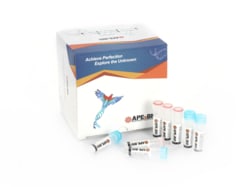
Apexbio Technology LLC Pyrophosphatase Inorganic (E. coli) 10 units
Pyrophosphatase Inorganic (E coli) purified from recombinant E coli strain carrying the E coli inorganic pyrophosphatase gene Inorganic pyrophosphatase (PPase) is a ubiquitous enzyme that catalyzes the hydrolysis of inorganic pyrophosphate into orthophosphate
Medchemexpress LLC W1131 TFA 10mM | 2740522-79-4 | C₂₅H₂₀F₃NO₈ | 1 ML
W1131 TFA is a potent STAT3 inhibitor and ferroptosis inducer. It demonstrates anti-cancer properties by inhibiting tumor growth and alleviating chemoresistance in gastric cancer models. W1131 TFA regulates critical cellular processes including the cell cycle, DNA damage response, and oxidative phosphorylation, specifically impacting the IL6-JAK-STAT3 and ferroptosis pathways.
- Potent STAT3 inhibitor
- Induces ferroptosis
- Inhibits cancer progression in subcutaneous xenograft, organoid, and PDX models of gastric cancer
- Alleviates cancer cell chemoresistance to 5-FU
- Regulates cell cycle and DNA damage response
- Modulates oxidative phosphorylation
- Impacts IL6-JAK-STAT3 pathway
- Affects ferroptosis pathway
Medchemexpress LLC ω-Agatoxin IVA TFA | 99.1% | 5316.27 | 1 MG
ω-Agatoxin IVA TFA is a potent and selective blocker of P/Q-type Ca2+ (Cav2.1) channels. It inhibits glutamate exocytosis and calcium influx induced by high potassium, and blocks the high potassium-induced release of serotonin and norepinephrine. This compound does not affect L-type or N-type calcium channels.
- Potent and selective blocker of P/Q-type Ca2+ (Cav2.1) channels
- Inhibits glutamate exocytosis and calcium influx induced by high potassium
- Blocks high potassium-induced release of serotonin and norepinephrine
- Does not affect L-type or N-type calcium channels
Sigma Aldrich Fine Chemicals Biosciences Trifluoroacetic Acid | CAS 76-05-1
Trifluoroacetic Acid | Purity: >=99.0% | M. W.: 114.02 | 76-05-1 | 200-929-3

Medchemexpress LLC FLAG peptide TFA | 99.6% | 1012.97 (free base) | 25 MG
FLAG peptide TFA is the TFA salt form of FLAG peptide. It is a multifunctional fusion tag used for the purification of recombinant proteins. It maintains the natural folding of its fusing proteins and can be removed by enterokinase, and eluted under non-denaturing conditions.
- Used as a multifunctional fusion tag
- Purifies recombinant proteins
- Maintains natural folding of fusing proteins
- Can be removed by enterokinase
- Eluted under non-denaturing conditions
Medchemexpress LLC Retatrutide TFA 10mg
Retatrutide, (LY3437943) is a triple agonist peptide of the glucagon receptor (GCGR), glucosedependent insulinotropic polypeptide receptor (GIPR), and glucagon-like peptide-1 receptor (GLP-1R). Retatrutide binds human GCGR, GIPR, and GLP-1R with EC50 values of 5.79, 0.0643 and 0.775 nM, respectively. Retatrutide can be used for the research of obesity. 10mg

Medchemexpress LLC FRETS-VWF73 | 97.3% | 8314.28 | 1 MG
FRETS-VWF73 is a 73-amino-acid peptide that serves as a fluorogenic substrate for the ADAMTS13 assay (Ex = 340 nm; Em = 450 nm). It is utilized as a predictive tool for thrombotic thrombocytopenic purpura and is intended for research use only.
- Functions as a fluorogenic substrate for ADAMTS13 assay
- Predictive tool for thrombotic thrombocytopenic purpura
- Excitation wavelength: 340 nm
- Emission wavelength: 450 nm
- Purity: 97.3%
- Molecular weight: 8314.28
- Appearance: Solid, light yellow to yellow
- Solubility: 25 mg/mL in DMSO
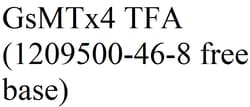
TARGETMOL CHEMICALS INC GSMTX4 TFA 1209500-46-8 5MG
Also available in 1 mg 2 mg 10 mg and bulk. Please contact Fisher for quotes. GsMTx4 TFA (1209500-46-8 free base) (GsMTx4 TFA) is a spider venom peptide that selectively inhibits cationic permeable mechanically-sensitive channels (MSCs) belonging to the Piezo and TRP channel families.
Medchemexpress LLC Gsnkskpk-nh2 (TFA) | 99.9% | 843.97 (free base) | 5 MG
GSNKSKPK-NH2 TFA is a model peptide based on a c-Src N-terminal peptide, which serves as an NMT substrate.
- Purity: 99.9%
- Appearance: White to off-white solid
- Sequence: Gly-Ser-Asn-Lys-Ser-Lys-Pro-Lys-NH2
- Molecular formula: C35H65N13O11.xC2HF3O2
- Soluble in water and DMSO
Medchemexpress LLC Maculatin 1.1 TFA | 96.9% | 2145.55 | 500 UG
Maculatin 1.1 TFA is an antimicrobial peptide that exhibits a Minimum Inhibitory Concentration (MIC) of 7 μM against *Staphylococcus aureus*. This peptide functions by perforating the bacterial membrane of *Staphylococcus aureus*, ultimately leading to bacterial death.
- Antimicrobial peptide.
- Effective against *Staphylococcus aureus* with an MIC of 7 μM.
- Works by perforating the bacterial membrane.
Medchemexpress LLC Mambalgin 1 TFA | 95.7% | 6554.54 | 100 UG
Mambalgin 1 TFA is a selective ASIC1a inhibitor with IC50 values of 192 nM for human ASIC1a and 72 nM for the ASIC1a/1b dimer. It binds to closed/inactive channels and exhibits selectivity for ASIC1a over ASIC2a, ASIC3, TRPV1, P2X2, 5-HT3, Nav1.8, Cav3.2, and Kv1.2 channels. It has been shown to increase the latency of withdrawal response in mouse tail-flick and paw-flick tests. This product is for research use only.
- Selective ASIC1a inhibitor
- Binds to closed/inactive channels
- Increases latency of withdrawal response in mouse tail-flick and paw-flick tests
- For research use only